Love is Personal


By Monica Mankinen, Founder of Daisy Davis Pit Bull Rescue
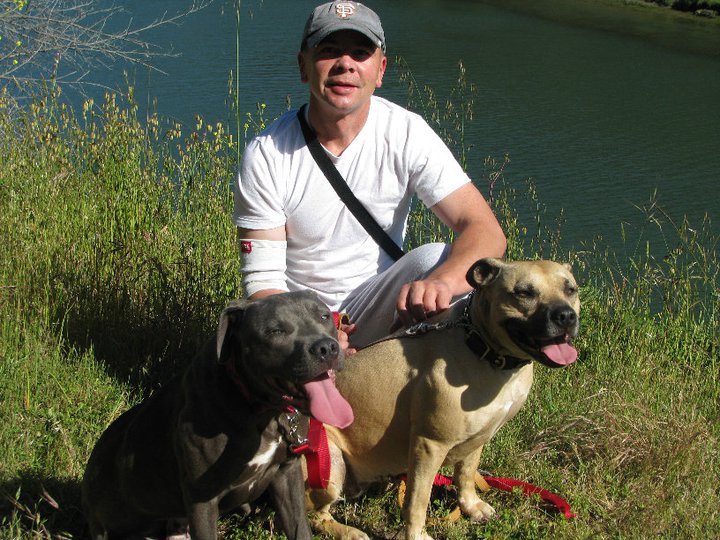
When Daisy entered my life, she inspired me to found Daisy Davis Pit Bull Rescue (DDPBR). She has inspired me every day since I met her, and as my life changed, so did my husband JoJo’s.

My husband has always been very supportive of DDPBR and has a close relationship with Daisy. He helps out with everything. Being a new rescue, we struggle with having enough help and he has always been there.

Even though he has been extremely supportive, JoJo has never been the one that has wanted to talk about the breed to people. Being a non-confrontational type person, he always has said, “You know, Monica, not everybody is going understand or care about what you have to say about the Pit Bull breed, some people just won’t like them.” I would reply, “But when they say these horrible things, they are talking about dogs just like Daisy.” For me, it is personal, I have met so many wonderful Pit Bulls and heard so many people say terrible things about the breed. But JoJo’s attitude was “If they don’t like our dog, screw them — we know she is a great dog.”

One day, DDPBR held a small adoption day out in front of a local store. At events like this, we always have all of our information on the breed and a board game — Find The Pit Bull — to engage with people. Looking out the window, I could see one of our volunteers, Megan, talking to this man. I saw the man talking to Megan and then I saw JoJo step into the conversation. That was unusual. I couldn’t hear what they were saying, but I saw JoJo holding a DVD and I could see he was talking to the guy and this time not keeping it short. Eventually they shook hands and the guy moved on.
In that moment something changed for JoJo. Without hearing a thing, I knew, I could see it, something had changed for him. I waited until the guy left, and then I asked our volunteer Megan what was going on. Megan said that when she would answer a question or try to say anything, the guy became chauvinistic toward her.

When I asked JoJo later what he said, he told me that the guy was talking sh** about Pit Bulls and wouldn’t listen to Megan. He also said that he told the guy, “I have a Pit Bull and you have it wrong, my dog Daisy is nothing like your idea of Pit Bulls.”

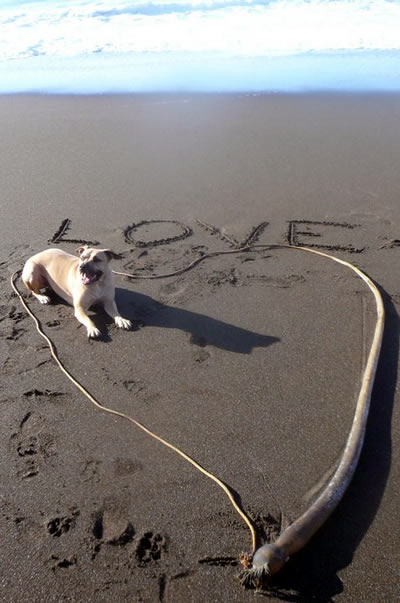
Since that day, I noticed that JoJo wears all of his Pit Bull shirts to work. He comes home and tells me stories about customers and things that he said in defense of the breed. This is what is true for me, LOVE IS PERSONAL. When you know love, you know what feels right. And JoJo loves Daisy and, therefore, not saying anything doesn’t work anymore.

______________________________________________________________

About Monica Mankinen:
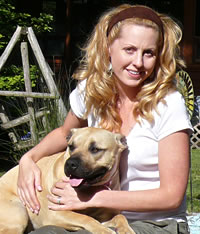
After years of volunteering and working with Pit Bulls and Bully breeds, I met Daisy and she changed my entire life. The love that I have for her has fueled me to speak out, open minds and bust myths about our most misunderstood breed — American Pit Bull Terrier — through Daisy Davis Pit Bull Rescue. I will never stop fighting for equal rights for this breed. I will never stop sharing my life with this breed. I will never stop loving this breed. I will never stop.
Hemorrhagic Gastroenteritis (HGE)


By Taylor Young: A Horrible End For A Wonderful Companion

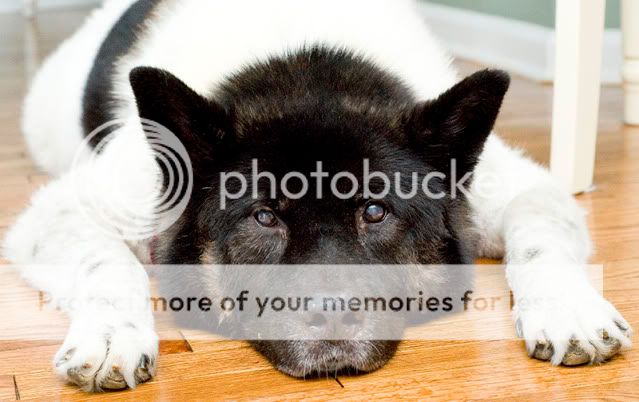
The last photo of Ansel Young (June 27th, 2009). Photo by Taylor Young.
 

This weekend, my best friend and oldest companion, Ansel, died. She was 8 1/2 years old. Even for an Akita, that’s young. She died of Hemorrhagic Gastroenteritis or HGE — an almost unknown disease which can take a dog’s life in a matter of hours. I decided to write this blog because of the lack of information on this subject.

I encourage all dog owners to contribute and share their thoughts and their own stories. The only thing which will save more dogs from this horrible fate is if we all inform each other.

What is Hemorrhagic Gastroenteritis?
It is a possibly fatal disease which can strike any dog at any time. There is no known cause for it other than some speculation that it could be a virus, or parasite. It could also be caused by allergies, a change in diet, stress and many other reasons.

How do I know if my dog has it?
The signs are blood in the dog’s vomit and bloody diarrhea. However, in Ansel’s case, she showed no clear signs of blood either in her vomit, or in her diarrhea. So watch closely. If you suspect that there is even the smallest amount of blood, rush your dog to the vet.

Is it curable?
Most of the cases of HGE have been cured. The most important thing is to recognize the signs early and act quickly. There is only about a 10-15% chance of fatality with treatment. That’s WITH treatment. Without treatment, as in Ansel’s case, fatality is almost guaranteed. There is also a 10-15% chance of HGE recurring in your dog once they’ve had it. So again, it takes dedication and diligence to spot it and get your dog to the vet.

What’s the treatment?
Hospitalization is a must. The vet will administer an IV with fluids, antibiotics and sometimes potassium. There is also a possibility of a blood transfusion in cases that need it.

What is the recovery time?
Most dogs should recover in a few days. In that time, their diet should consist of bland foods like boiled rice and boiled burger. After a week, or so a normal diet can resume.

Link to helpful sites:

______________________________________________________________

About Taylor Young:

taylor-youngA professional photographer and marketing consultant based in East Grinstead, West Sussex, England, I’m originally from Florida and worked in Pennsylvania. I specialize in weddings, food, travel, portrait and corporate photography. The love of my life is my Akita, Ansel Young, my constant companion for 8 1/2 years whose sudden death left me heartbroken. She filled my life with love and many pleasant memories. You can see my work at Taylor Young Photography, Passport Foodie and my blog.

Blind Dog Tips


Content courtesy of BlindDogs.com

Are you an owner of a newly blinded dog or have adopted a blind/ visually-impaired dog or puppy? If you are new to this situation, you’re probably feeling overwhelmed right now.

Regardless if you’re new or have been at this for awhile, there are many websites and message boards out there with support and information you need to help both you and your dog. If you’re new to this situation, rest assured it does get much better. Most dogs adjust well and lead happy near-normal lives. Before long you will be amazed at what a blind dog can do!

Just take a look at the wonderful Stevie The Wonder Dog, a therapy dog who was born without sight.

You’re not alone in your situation, although it may feel like you are right now. Finding websites like BlindDogs.com or BlindDogs.net is the first step to helping both you and your dog. If you are considering adopting a blind/visually-impaired dog and not sure what to expect, well for the most part a visually-impaired dog is not that much different than a sighted one, even if it’s a puppy. Most blind puppies are born blind so this is the way the world is to them.

When a dog looses their sight or was not born with sight, they come to rely on their other senses and often times these senses become even keener over time. So always emphasize their other senses of smell, hearing, taste and touch in your training of your blind dog or puppy.

Here are some tips to help you get started with your blind dog:

  1. Try not to move furniture around or leave obstacles on the floor

  2. Remember we take things so much harder than they do and they also pick up on our emotions.  So try to express  “happy” emotions around your blind baby

  3. Emphasize the senses they still have:
    A blind dog/pup—their sense of smell, hearing, taste and touch
    A blind/deaf dog—their sense of smell, taste and touch (they can feel vibrations—especially when you walk)

  4. Ask people to let your dog “smell” their hand before touching them. Most blind dogs personalities don’t change. Some dogs however can easily become “startled” and this could  also lead to fear biting in some dogs

  5. Try to treat them as normal as possible. Building their confidence is key to letting them know they can still do things and that you still love them. Let them know they are still the same  dog in your eyes. For a blind pup it can be the basis for what type of personality they will developed

  6. Coax, encourage and praise them to do the same things they did before. However, understand and still praise them if they “can’t”

  7. Be creative with different scents to mark areas for your blind babies—just make sure it’s safe for them. You can use different scents of flavored extracts or even something as simple as hanging a car air freshener or potpourri sachet on a door. Using different scented candles in each room may also help your dog distinguish from different rooms in your house

  8. Use textured materials to mark areas. Throw rugs and decorative pillows are great (and people don’t even realize their “Real” purpose). Indoor/outdoor carpeting, wind chimes and something as simple as cedar chips or decorative bricks or blocks can help guide them along their way outside

  9. Use bells or jingling tags on your other dogs not only help your blind babies to find/follow your other dogs, but will also avoid them from being startled by your other dogs. You can also use bells on your shoes to help them find you

  10. Don’t be afraid to walk with a “heavy foot” when approaching them especially with a blind/deaf baby….they can still feel vibrations

  11. Don’t under estimate the power of touching and massage

  12. Be very vocal with your dog

  13. A tabletop fountain can be used as a water bowl. Get a simple one with a large bowl and the sound of running water helps to orient the blind dog and helps him to find his water bowl as well as know where he is from the sound. Some dogs like drinking from running water too! This can be especially helpful if you have to move to a new home with a blind dog

  14. Make sure your dog has a safe place to go. Jen Milner, Stevie’s mom, has a crate for him with a comfy bed in it. If anything is off in the house, like furniture rearranging or vacuuming, he’ll go hang out in it until things are back to normal.

  15. Clicker training is highly recommended with blind dogs. If you’re stuck on something, you can use the clicker noise to give him hints of what to do

“In general, positive training is really important with blind dogs,” Jen pointed. “It keeps them motivated and confident.”

Always remember, dogs that are blind generally cope with it better than their humans. They already have a much better nose and hearing than humans, so they are off to a good start. These senses will get even better with time. Time is important, for dog and human, it might take just days, and rarely it could be years.

For owners of newly blind dogs, it’s a horrible thing to go through. However, Lea Slaton, whose dog Peanut lost her sight due to a tick-borne disease, ehrlichiosis, said that Peanut’s dependence on her only makes the connection between them tighter. “I love both of my dogs so much, but the bond you form with one with an impairment is amazing,” she said.

“They trust you enough to run beside you, to step up when you step up. The blind trust they put in you is incredible.”  Owners of newly blind dogs need to hold on and let that develop. “The dog will adjust,” she said. “It’s not the end of the world.”

More tips & suggestions to help you and your blind dog:

Juvenile Cellulitis: A Puppy’s Ultimate Struggle


Content courtesy of Pet Education and Fido’s City Guide

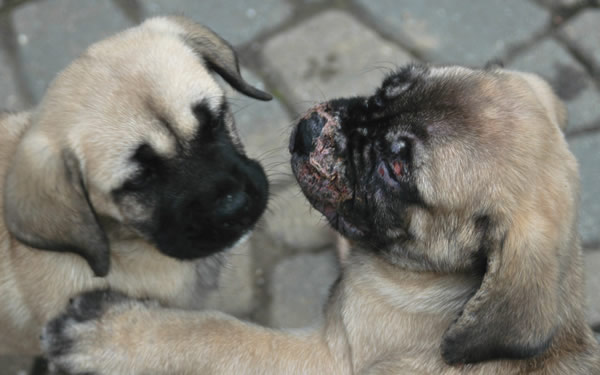
Juvenile cellulitis is an infection among puppies between the ages of 3 to 16 weeks. Puppy breeds that are easily infected by the disease include Golden and Labrador Retrievers, Dachshunds, Gordon Setters, and Lhasa Apsos. As you can see, it can also infect Mastiffs like SkarFace above.

The cause of the disease is still unknown but some evidence shows that it may be hereditary. Others say that it is due to an abnormality or dysfunction in the immune system of the said puppies. Taking good care of these young pets would require you to administer the right treatments and healthcare in order to protect them from the adverse effects of this skin disease.

Symptoms

Juvenile cellulitis, or also called puppy strangles, usually affects the ears, face, and the corner of a puppy’s jaw. The face, especially the eyelids, the lips and the muzzle, become swollen. Breaks and cracks appear on these affected areas as the disease progresses. The corner of the puppy’s jaw where submandibular lymph nodes are located also swell leading puppies to have difficulties in swallowing and eating.

Sometimes, the puppy has difficulty eating and swallowing because of the enlarged lymph nodes. Puppies infected by the disease are usually quiet and suffer from fever, are depressed, and will not eat. Papules or small round bulges start to appear as the disease worsens and these papules break, open and turn into crusts on the puppy’s skin. The submandibular lymph nodes enlarge and may abscess and drain. These infections usually become painful after a certain amount of time. Once this condition was untreated, scarring and permanent loss of hair will occur but the ultimatum will still be death.

Causes & Risks

The cause of juvenile cellulitis is unknown, but is thought to be an immune system abnormality. There is some evidence that the condition can be hereditary. If left untreated, some puppies can die from this condition. Scarring and permanent hair loss can occur.

Treatment

Other names associated with juvenile cellulitis are puppy strangles, puppy glad disease and juvenile pyoderma. Aggressive medical examinations and treatments should be done at once to puppies infected by the said disease otherwise it will all be too late. A high dosage of Corticosteroids is the main medication given to the puppies. The treatment is done for 3 to 4 weeks and the puppies will gradually respond to the medication during this timeframe. Antibiotics, such as cephalexin, amoxicillin clavulanate, and the likes, can also be prescribed if a secondary bacterial infection is detected. This treatment should be done as early as possible otherwise the scarring of the infected area may become severe.

Waiter, There’s A Dog in My Kitchen


Reblogged from Bruce Buschel’s post for The New York Times’ Start-Up Chronicle

A sous chef stirs vegetables for the clam chowder for table 74 when he absently looks downward and sees something unusual and says, “Whose pit bull is this?”

Everyone freezes. Walking around the kitchen is a large, muscular pit bull. Some dogs have been known to be unreasonable when it comes to the proprietary rights to found objects, particularly food. The chefs are too busy for any canine contretemps, too petrified too, so they carefully show the dog the door. Chef Joe flies through the swinging doors into the dining room and grabs my arm.

“I need you. Come with me. Now.” My heart skips a few fibrillating beats. A prelude such as this invariably leads to no good. Deposited at the front door, which is in the back of the restaurant, Chef Joe points to the window. “Look. Out there. You have to do something. You’re the dog man around here. I have to go back to work.” And he is gone.

There she is. Black and white and lost all over. I’ve heard the same stories you have about pit bulls. I approach her slowly, hands flexed into fists. She is panting. She must have traveled far on this humid summer night. There is blood on her forehead, not gashes, just scratches from a bush or a fence. I check her for a name tag or number. She has a brown leather collar without identification. Seeing jaws this big and this strong at this range, I gulp. Her cut-off tail is wagging. I pet her timorously. It’s like rubbing a marble statue with a two-day beard. I bring her water. She drinks moderately, not like a dog in trouble. She is well groomed and conditioned. She must weigh 65 pounds and has less body fat than Marky Mark. She was obviously sculpted by someone higher than Michelangelo. She was also given a disposition sweeter than our butterscotch pudding.

“You can’t go in the kitchen, Sofo” — I call her Sofo for Southfork — “but I’ll bring you some food. Stay right here on the porch.” I fetch some bread and butter. She chews the brioche and spits it out. Politely, but decisively. Same with the whole grain bread. Starving she is not.

“What’s the problem, Sofo?”

She looks at me as if to say, “Bread? You bring me bread? Are you blind?”

“I’m sorry, but we don’t serve meat in this restaurant.”

“I thought all seafood places had a steak or a burger or something.”

“Not you too, Sofo.”

(more…)

Top